
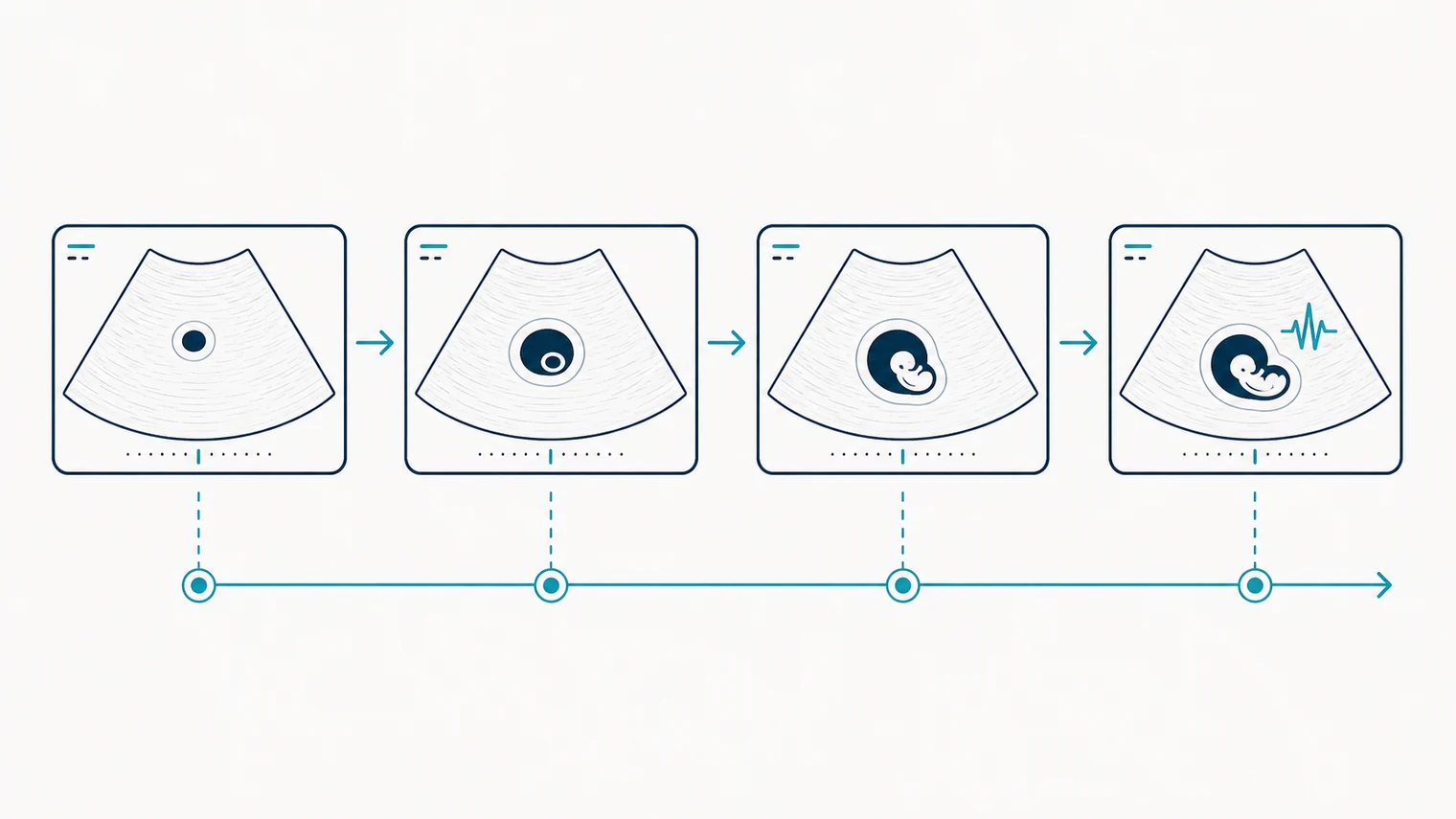
Finding out you're pregnant is exciting, and sometimes a bit overwhelming. If you're around 4 weeks pregnant and thinking about an early ultrasound, you've probably got plenty of questions. Australian guidelines suggest that 4 weeks is usually too early. Here's what you need to know.
Key Takeaways (TL;DR)
- 4 weeks is too early. Australian guidelines don't recommend routine scans at this stage.
- Gestational sac visibility at 4 weeks is uncertain, and it may not appear at all.
- No heartbeat, yolk sac, or embryo will be visible at 4 weeks.
- ASUM recommends first-trimester ultrasounds from 5-14 weeks.
- The best dating scan timing is 7–10 weeks for accuracy.
- Modia Health offers mobile ultrasounds at the recommended timing.
Ready for your scan at the right time? - Book your home pregnancy ultrasound today!
Is It Safe to Get an Ultrasound This Early?
Yes. Ultrasounds are completely safe during pregnancy when they're performed by trained professionals.
Sound Waves Only
Ultrasounds use sound waves, not radiation, so they're completely non-ionising
No Known Risk
There's no established risk to baby or parent when scans are performed appropriately
ALARA Principle
Australian practitioners follow "As Low As Reasonably Achievable" exposure guidelines
Important: Doppler in First 10 Weeks
Ultrasound is safe, but Doppler ultrasound (which shows blood flow) should not be used routinely in the first 10 weeks because of its higher acoustic output. Standard B-mode imaging is preferred for early pregnancy.
How Pregnancy Weeks Are Counted (And Why 4 Weeks Can Be Confusing)
Pregnancy is counted from the first day of your last menstrual period (LMP), not the day of conception.
Understanding the LMP Dating System
Pregnancy Calculator: When Should You Get Your Scan?
Why 4-Week Scans Are Not Recommended
At 4 weeks of gestation, a dating scan is not clinically useful and is not recommended by Australian ultrasound guidelines.
The Australasian Society for Ultrasound in Medicine (ASUM) notes that a gestational sac should usually be visible from 4 weeks and 3 days with high-frequency transvaginal ultrasound, but a scan at exactly 4 weeks gives minimal diagnostic information and creates more limitations than benefits.
"There is no reason to offer routine ultrasound simply to confirm an ongoing early pregnancy in the absence of any clinical concerns, pathological symptoms or specific indications."
What You'll See at 4 Weeks: Almost Nothing
At this very early stage, an ultrasound usually shows only a tiny dot, the gestational sac, which is often barely distinguishable from other findings on the screen. The blastocyst is still busy dividing into an embryo and placenta, with virtually no other identifiable structures yet.
hCG Levels and Visibility: The Science
The visualisation challenge at 4 weeks comes down to hCG (human chorionic gonadotropin) levels. Research shows clear thresholds for when ultrasound can pick up pregnancy structures.
Gestational Sac Visibility by hCG Level
Probability of seeing gestational sac on transvaginal ultrasound
What You Can See at Each Week
| Week | What's Visible | Key Milestones | Recommended? |
|---|---|---|---|
| 4 weeks | Gestational sac (maybe) | No heartbeat No yolk sac No embryo | Not recommended |
| 5 weeks | Gestational sac + yolk sac | No heartbeat yet Yolk sac visible | High-risk only |
| 6 weeks | Embryo + possible heartbeat | Heartbeat often visible Embryonic pole | If indicated |
| 7-8 weeks | Clear embryo + heartbeat + measurements | Reliable heartbeat CRL measurable Twins detectable | Optimal timing |
| 9-10 weeks | Developing fetus + all structures | All markers visible Dating most accurate | Optimal timing |
Optimal Timing: Australian Guidelines
What Australian Health Authorities Recommend
Australasian Society for Ultrasound in Medicine
Guidelines designed for first-trimester ultrasounds from 5 to 14 weeks
Pregnancy Birth and Baby (Australian Government)
Dating scans "usually done between 8 and 14 weeks of pregnancy (most often before 12 weeks)"
Recommended Scan Windows
Clinical Indications for Very Early Scans (Before 7 Weeks)
For women with certain risk factors, an earlier scan before 7 weeks can be justified:
History of Miscarriage
Previous pregnancy loss or recurrent miscarriage requiring early monitoring
History of Ectopic Pregnancy
Previous tubal pregnancy requiring confirmation of intrauterine location
IVF/Fertility Treatment
Assisted conception requiring monitoring of implantation success
Pain, Bleeding, or Cramping
Symptoms requiring assessment to rule out complications
Uncertain Dates
Irregular cycles or uncertainty about last menstrual period
Important Note
Even in these cases, an early scan at 6–7 weeks is usually recommended rather than 4 weeks. At 4 weeks, the gestational sac may not be clearly visible, or it may be too small for reliable assessment.
Viability Scan vs Dating Scan: What's the Difference?
Viability Scan
Typically 6-8 weeks- Confirms pregnancy location (uterus vs. fallopian tubes)
- Checks for fetal heartbeat
- Assesses early development
Dating Scan
Typically 7-10 weeks- Measures crown-rump length (CRL)
- Establishes estimated due date (EDD)
- Detects multiple pregnancies
At 4 weeks, neither purpose can be properly met. The gestational sac may be barely visible, and all the markers of viability and dating are absent. That's why the recommended approach is to wait until 6–7 weeks for viability assessment, or 7–10 weeks for accurate dating.
What to Expect at the Recommended Timing (7–10 Weeks)
When you come in for a dating scan at the recommended window in Australia, here's what the sonographer usually does:
Dual Ultrasound Approach
Both abdominal and transvaginal ultrasound may be used to get the clearest images
Crown-Rump Length Measurement
Measures the CRL to work out gestational age accurately (within ± 5 days)
Heartbeat Documentation
Confirms and records the fetal heartbeat
Multiple Pregnancy Check
Confirms whether you're carrying a single baby, twins, or multiples
Early Abnormality Assessment
Checks for any visible early abnormalities
Pregnancy Location Confirmation
Checks the location within the uterus and examines the ovaries
What to Know
The scan usually takes 15–30 minutes and is completely non-invasive. At 7-10 weeks, you'll get useful information including confirmation of viability, an accurate due date, and peace of mind about your pregnancy's progress.
Medicare & Costs in Australia
May attract a Medicare benefit
- Doctor visits and referrals
- Standard early (6–8 week) dating scans
- Anatomy scans (18–20 weeks)
- Midwife or obstetrician care (public system)
Private/Additional Scans
- Private clinic dating scans
- Extra reassurance scans
- 3D/4D imaging
- Gender reveal scans
Can I Get a Pregnancy Ultrasound at Home?
Yes, you absolutely can.
With Modia Health's mobile ultrasound service, you can have your scan done in the comfort of your own home at the recommended timing.
Hospital-Grade Equipment
Portable ultrasound technology that meets clinical standards
Certified Sonographers
Friendly, qualified professionals who come to you
Ideal for Rural Areas
There's no need to travel long distances for scans
Comfort & Privacy
Less anxiety when you're in familiar surroundings
Book Your Home Pregnancy Ultrasound
Skip the clinic, stay comfortable, and get peace of mind at the recommended timing for accurate results.
Summary: What Australian Guidelines Really Say
Sources & Citations
This article is based on current Australian clinical guidelines and peer-reviewed research:
Australian Guidelines
- Australasian Society for Ultrasound in Medicine (ASUM), Guidelines for First Trimester Ultrasound
- Pregnancy Birth and Baby, Australian Government Health Service
- Royal Australian and New Zealand College of Obstetricians and Gynaecologists (RANZCOG)
Clinical Research
- hCG levels and gestational sac visualization studies
- Crown-rump length dating accuracy research
- First trimester ultrasound safety literature
Health Resources
- Healthdirect Australia
- American College of Obstetricians and Gynecologists (ACOG)
- Annals of Emergency Medicine
*This information is for educational purposes only and should not replace professional medical advice. Always consult with qualified healthcare providers for proper diagnosis and treatment recommendations.*


